


Why Do Gay Men Marry Women? The Psychology Behind Coming Out Late
By William Brown, LMHC, LPC
I grew up in a small town in Kansas in the 1970s. The only images I ever saw of gay men were negative, foreign, and frankly terrifying — effeminate caricatures, hell-bound sinners, men living in shadows. When I looked at those images and compared them to myself — a boy who wanted to get married, have a family, believe in God — I saw no resemblance. Therefore, I was not gay.
Never mind that I found other boys attractive in ways I couldn't explain. Never mind the quiet, persistent hum of something I worked very hard not to name. I had constructed a narrative, brick by brick, that made that truth invisible to me. Not to everyone around me. To me.
I came out at forty, after nineteen years of marriage and two children. Since then, I have spent nearly 15 years working with dozens of men who share a version of that same story. And the question I hear most often — from spouses, from adult children, from friends trying to make sense of it all — is some version of this:
How did he not know? How could he not see it?
It's a fair question. And the answer is more complicated, and more human, than most people expect.
It starts with what being gay was allowed to mean
Before we can understand why gay men marry women, we have to understand what being gay meant in the world many of these men grew up in.
For a boy coming of age in the 1970s, 80s, or even 90s, the cultural message was consistent and merciless: being gay meant living a life defined by shame, rejection, and danger. The AIDS epidemic arrived in the early 80s and was dubbed "the gay plague" — a message that being gay was not just morally wrong but potentially fatal. Religious teachings hammered home that same-sex attraction was sinful, disordered, and an obstacle to God's love. Families communicated, sometimes explicitly and sometimes through silence, that a gay son was not what they had hoped for.
When a young man absorbs all of this and then notices that he is attracted to other men, he faces a choice that can feel like it has only one viable option. He can either accept that he is one of those people — the people his whole world has told him are broken, dangerous, and damned — or he can find another explanation.
Most choose another explanation. And because they desperately want that explanation to be true, they find evidence for it everywhere.
Denial is not the same as lying
This is the part that matters most, and the part that is most often misunderstood.
When a man spends decades believing he is straight — marrying, having children, building a life — he is not lying to his wife. He is not executing a calculated deception. He is doing something psychologically distinct, and in some ways more complex: he is in denial.
Denial, in the clinical sense, is not a conscious choice. It is the mind's way of protecting itself from a truth that feels unsurvivable. In order to be in denial, you don't have to see the truth and hide it. You have to genuinely, completely not see it at all.
A man who marries a woman while experiencing same-sex attraction is, in most cases I've worked with, doing exactly that — seeking the straight relationship not as a cover story, but as proof to himself that he is who he needs to be. Every loving moment with his wife, every successful sexual experience, every year of marriage becomes another brick in the wall of his belief. See? I'm not gay.
This doesn't excuse the hurt that results when the truth eventually surfaces. The pain is real and it is significant. But understanding that the deception was primarily self-directed — that the man was not strategically deceiving his wife so much as desperately trying to deceive himself — can impact the conversation we can have about healing.
Three forces that build the wall
In my years of clinical work with this population, and in my own experience, three forces consistently do most of the heavy lifting in sustaining denial.
Family. Most boys are raised with the implicit — and sometimes explicit — expectation that they will grow up, meet a woman, and start a family. This expectation isn't malicious. It comes from parents who love their children and want the easiest, most accepted life for them. But it communicates clearly: this is what you are supposed to become. For a boy already frightened by feelings he can't name, the path of least resistance is to become exactly that.
Culture. For men who came of age before the last decade or two of cultural shift, there were virtually no positive images of gay men in mainstream life. No gay couples in movies, no gay athletes, no gay politicians leading normal, admired lives. The only visible gayness was stigmatized or hidden. A boy trying to imagine his future literally could not see one that included being gay and being okay.
Faith. For men raised in religious households — and this is an enormous proportion of the men I work with — the theological verdict on homosexuality was clear and terrifying. Being gay was a sin. Acting on it was worse. Pray harder, marry a good woman, and these feelings will be washed away. Many men spent years, sometimes decades, earnestly trying to pray themselves straight. The fact that it never worked was experienced not as evidence that it was impossible, but as evidence of their own spiritual failure.
When all three of these forces align — and they often do — the foundation for a life-defining denial is almost unavoidable.
What finally breaks through
So what changes? What eventually makes the wall come down?
In my experience, it's usually one of three things — and often a combination of all three.
The first is getting caught pursuing same-sex experiences that had been carefully hidden. The second is falling in love with another man for the first time — and realizing in that moment that what he felt for his wife, real as it was, was something different from this. The third, and perhaps the most common underlying factor, is that the anxiety and depression of holding this secret simply becomes unbearable. The weight of carrying it grows heavier every year until it becomes physiologically impossible to keep carrying.
I had clients who reached out to me for the first time after sitting with a loaded gun, or after fashioning a noose out of a belt, so desperate to escape the pain of the secret that they couldn't see any other exit. I experienced something similar in my own journey. That is not hyperbole — it is the reality of what sustained, deep self-denial does to a person over decades.
What this means if this is your story
If you are reading this and recognizing something of yourself in these words — if you are somewhere on the road between that first, frightening moment of self-honesty and whatever comes next — I want to say something directly:
You are not broken. You are not a bad person. The forces that shaped your choices were real and they were powerful, and understanding them is not an excuse — it is the beginning of being able to move forward with honesty and dignity.
This process is survivable. On the other side of it, most of the men I've worked with find something they genuinely didn't expect: a life that finally feels like theirs.
If you want to talk, I offer a free thirty-minute phone consultation — no pressure, no commitment. Just a conversation with someone who has been where you are and spent thirteen years helping others find their way through it.
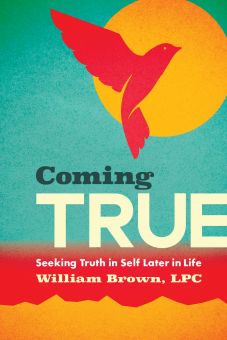
William Brown is a Licensed Mental Health Counselor in Florida and Licensed Professional Counselor in Georgia, specializing in gay men and men coming out later in life. He is the author of Coming True: Seeking Truth in Self Later in Life and has led the Out Late group therapy program since 2012. He can be reached at comingtruecounseling.com.
No Articles have been published. Please try back again later.